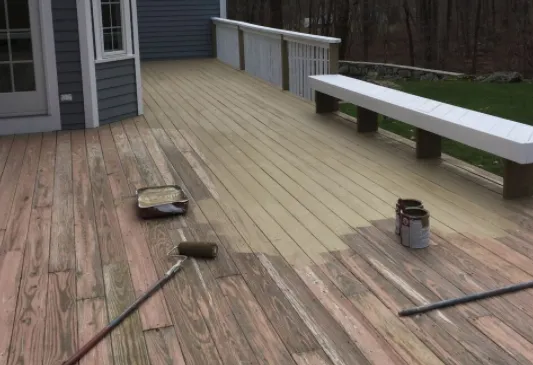
Prep is most of what you pay for in a paint job, and it decides how long the paint lasts. Paint sticks to what is under it. If that is dust, grease, chalk, loose paint or damp wood, the new coat fails with it. This page covers the prep questions we hear most in Modesto.
Do I need to prime before painting?
You need primer on bare surfaces, on repairs, on stains and when the old paint is glossy or chalky. You do not need to prime a whole wall of clean, sound, flat paint before repainting it in a similar color.
- Bare wood, bare drywall and bare stucco: always prime.
- Patches and filled holes: spot prime.
- Water, smoke, tannin and marker stains: use a stain-blocking primer.
- Glossy trim or oil-based paint: sand and use a bonding primer.
- Chalky exterior paint: wash it, then prime if chalk remains.
Do I need primer if the old paint is in good shape, and can you paint over old paint?
Yes, you can paint over old paint, and no, sound old paint does not need a full coat of primer. It needs to be clean, dull and firmly attached. Wash it, sand any gloss, spot prime the repairs and paint.
Paint and primer in one products are thick paints. They work well over sound old paint. They are not a stand-in for a true primer on bare wood or stains.
Do I need to sand the walls before painting?
Most walls need a light sanding, not a heavy one. Sanding knocks down bumps, roller lint and the edges of patches, and it dulls any sheen so the new coat grips. Flat wall paint in good condition needs very little.
Trim, doors and cabinets are different. They are usually glossy and must be sanded or deglossed. In a home built before 1978, do not dry sand old paint until you know whether it contains lead.
Do painters fix nail holes, cracks and dents first?
Yes. Filling nail holes, small cracks and dents is a normal part of interior prep, and it is in our quotes. Larger repairs, such as holes, lifted tape seams and water damage, are listed as separate items.
Nail pops and cracks at the corners of doors and windows are common in Modesto homes. Each repair is sanded and primed so it does not show through the finish.
How do I paint over a water stain so it does not bleed through?
Seal the water stain with a stain-blocking primer first, then paint. Ordinary wall paint will not hold a water stain back. It bleeds through again in days, however many coats you apply.
Fix the leak before anything else and let the area dry. If the drywall is soft or sagging, that section should be replaced, not painted.
Can you paint over smoke stains or pet smells?
Yes, with the right primer. Smoke residue and odors pass through normal paint. The walls and ceilings are washed and then sealed with a stain and odor blocking primer, usually shellac or oil based, before the finish coats.
Heavy cigarette smoke gets onto every surface, so ceilings, closets and trim need the same treatment. Pet odor that has soaked into flooring or subfloor has to be dealt with at the floor. Paint on the walls will not remove it.
There is mold on the bathroom ceiling. Can it just be painted over?
No. Mold painted over grows back through the new paint. It has to be cleaned off, the surface dried and the cause dealt with, which is nearly always poor ventilation.
Small surface mildew on a bathroom ceiling can be washed, primed with a stain-blocking primer and painted with a bathroom paint. Run the fan during showers and for a while after. If mold covers a large area or keeps returning, have it looked at by a mold specialist. Nationally, remediation of a small area is published at $500 to $1,500.
The paint is peeling to bare wood on my old house. What prep does it need?
Paint peeling to bare wood needs all loose paint scraped off, the edges sanded smooth, the bare wood primed with an exterior primer and open joints caulked. Then two finish coats go on.
Sun-baked wood in Modesto is often grey and dry where the paint has gone. Grey wood fibers are weak, so they should be sanded back to sound wood before priming. If the house was built before 1978, the old paint may contain lead and must be handled with lead-safe methods.
Why is my paint peeling?
Paint is peeling because it has lost its grip on what is under it. The usual causes are moisture behind the paint, a dirty or chalky surface, no primer on bare wood or paint put over a glossy coat without sanding.
Outside in Modesto, the pattern tells you a lot. Peeling on south and west trim is sun and heat on dry wood. Peeling low on a wall is usually sprinklers. Peeling under eaves and around gutters points to water.
Why is paint bubbling or peeling in my kitchen or bathroom?
Paint bubbles and peels in kitchens and bathrooms because of steam and grease. Moisture gets behind the paint film and lifts it, and grease stops new paint from bonding at all.
The fix is to scrape and sand the failed areas, wash off the grease, prime and repaint with a paint made for damp rooms. Outside, blisters have a different cause here: paint applied to a hot wall in direct sun skins over and traps solvent under it.
How do I know if old paint is oil or latex, and can latex go over oil?
Rub the paint with a rag wet with rubbing alcohol. If color comes off on the rag, it is latex. If nothing comes off, it is oil-based. Old trim and doors are the usual places to find oil-based paint.
Latex can go over oil only after prep. Sand the surface dull, clean it and apply a bonding primer. Latex put straight onto glossy oil paint peels off in sheets.
Do bare drywall patches need primer?
Yes. Every drywall patch needs primer before paint. Joint compound is more porous than the painted wall around it and soaks up the finish coat, so an unprimed patch shows as a dull, flat spot.
That dull spot is called flashing. Priming the patch, and often repainting the full wall from corner to corner, is what makes a repair disappear.
Does stucco need special prep before painting?
Yes. Stucco needs to be washed, left to dry and have its cracks filled before paint. Chalk from the old paint and dust must come off, or the new coat bonds to powder.
Hairline cracks are filled with a flexible patching compound. New stucco patches are alkaline and need time to cure, plus a masonry primer, before they are painted. See our page on painting siding, stucco and brick.
Questions about your own walls? Call or text (209) 231-7078 for a free estimate.